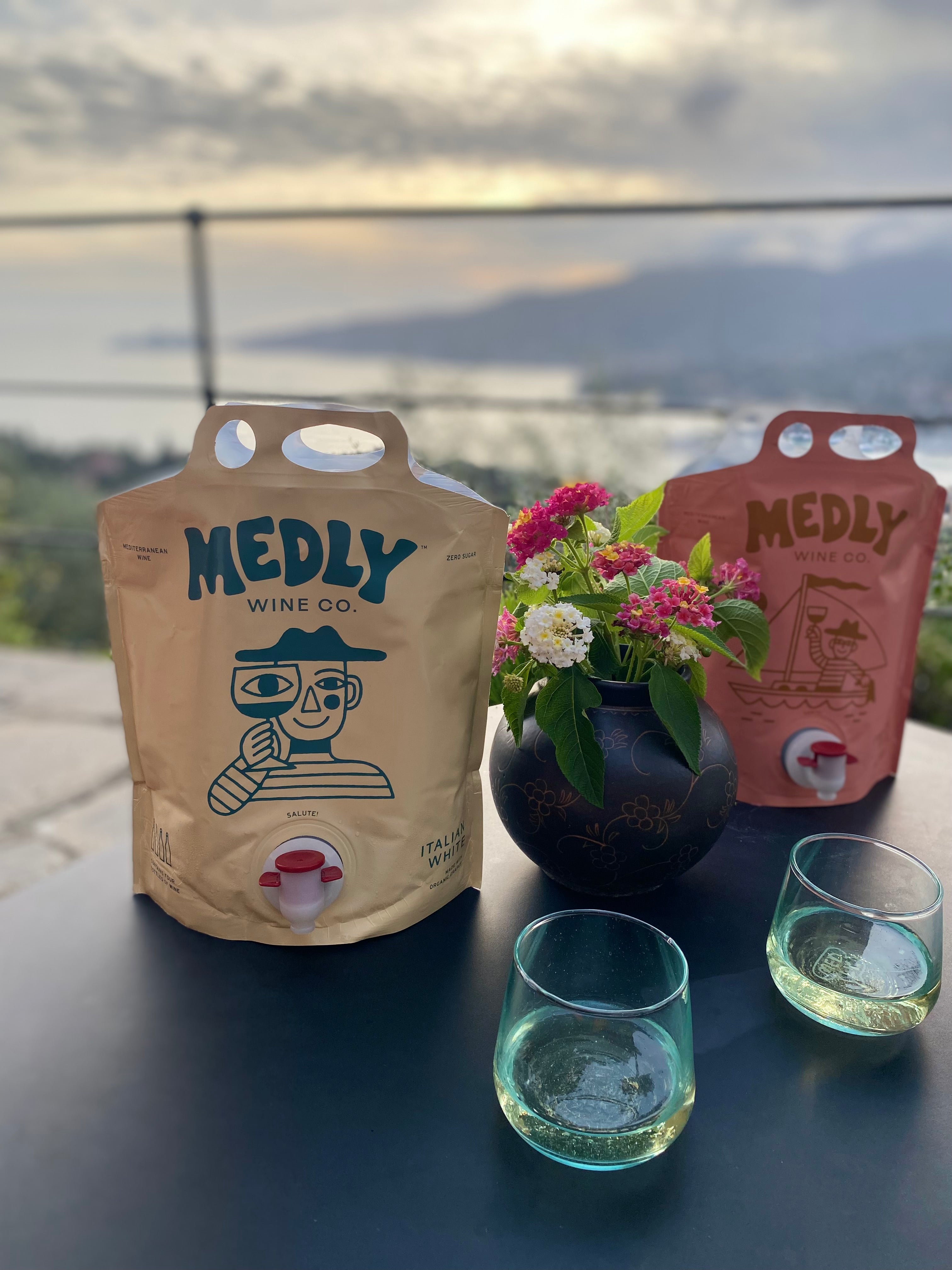
The main Mediterranean wine regions are Languedoc-Roussillon and Provence in France, Sicily and Sardinia in Italy, Catalonia in Spain, and the island of Santorini in Greece, and together they sit at the center of organic winemaking. France, Spain, and Italy hold about 75 percent of the world's certified organic vineyards, and long, dry summers make vines in these places easier to farm without synthetic sprays.
In this guide, Mediterranean means the wider region and its climate, not a strip of beach. Some of these vineyards sit by the water, while others climb hills far from it. You'll meet each region, the grapes worth knowing, and the places where Medly's own grapes grow.
What are the main Mediterranean wine regions?
Six regions give a fast tour of Mediterranean wine, running from pale dry rosé in Provence to a salty, high-acid white grown on a Greek volcano. The table shows where each one sits and what to look for in the glass.
|
Region |
Country |
Grapes to know |
What you will taste |
|---|---|---|---|
|
Languedoc-Roussillon |
France |
Grenache, Syrah, Carignan, Mourvèdre, Cinsault |
Spiced red blends, plus rosé and white |
|
Provence |
France |
Grenache, Cinsault, Mourvèdre, Rolle |
Pale, dry rosé |
|
Sicily |
Italy |
Nero d'Avola, Grillo, Inzolia |
Bright whites and juicy reds |
|
Sardinia |
Italy |
Cannonau, Vermentino |
Warm reds and crisp whites |
|
Catalonia |
Spain |
Garnacha, Xarel·lo |
Sparkling Cava and dark, slate-grown reds |
|
Santorini |
Greece |
Assyrtiko |
Dry, citrusy, sea-salty white |
Start with whichever row sounds like your glass. The sections below take each region in turn.
Why is the Mediterranean the epicenter of organic winemaking?
Start with the numbers. According to Agrovin, which summarizes a report from the OIV (the international wine body), Spain, Italy, and France held 75 percent of the world's certified organic vineyards in 2019. Spain alone led the world, with 27 percent. Inside those countries, the Mediterranean regions stand out. SevenFifty Daily reports that Languedoc holds 36 percent of all organic French vineyards, the most of any French region. SevenFifty adds that Sicily holds 34 percent of Italy's organically farmed vines, the largest share of any Italian region. The European Union subsidizes organic farming, helping growers who commit to the practice. Conversely, the U.S. government subsidizes mass-scale commercial farming that uses sythetic pesticides and herbicides which makes growing organically at scale much harder for family farms.
Catalonia took it a step further. Cellar Tours says that from the 2025 harvest, every wine carrying the DO Penedès name must be organically certified, and a DO, or denominación de origen, is Spain's legally protected wine name tied to one place.
Climate explains much of this. Dry summers and steady wind keep damp air and mildew, the two things vines dislike most, under control. Languedoc's climate and strong winds give its vineyards natural protection from pests and disease. Sicily's warm, mostly dry weather works the same way.
The habit is also old. Greek settlers brought vines to Languedoc in the 5th century BCE and built up vine growing on Sicily from the 8th century BCE, and Santorini's growers have worked the same volcanic soil for about 3,500 years. Written organic rules came much later, and our post on why Europeans lead the way in organic grape growing tells that story. To see what the farming asks of a grower, read what organic growing demands from a vineyard. Our country-by-country guide to wines from the Mediterranean covers Italy, France, Greece, and Spain.

Which French wine regions are part of the Mediterranean?
Three French regions belong here: Languedoc-Roussillon, Provence, and Corsica, with Languedoc-Roussillon being the biggest, with more than one in three French wines coming from there.
Languedoc-Roussillon
Most of its wine is red blends of Grenache, Syrah, Carignan, Mourvèdre, and Cinsault, and you'll often taste garrigue in them, meaning the wild rosemary, thyme, sage, and lavender that grow between the vines.
Our French Red and French Rosé come from this region, and both grow on a family estate in Corbières-Boutenac, a district of Languedoc. The same family has farmed there since 1605, and ECOCERT, an organic certification body, has certified the vineyards since 1991. The French Red is a Grenache-forward blend, and the French Rosé comes from the same estate.
Provence
Provence sits east of Languedoc, and it's the name you most likely link with rosé. Taste France Magazine backs that up by saying Provence makes more than 40 percent of all rosé in France. The grapes are mostly Cinsault, Mourvèdre, Grenache, and Rolle, which is also called Vermentino, and our essential guide to rosé wine explains rosé styles, color, and structure.
Corsica
Corsica is France's only island wine region, and salty breezes keep its vineyards well ventilated. Its main grapes are Nielluccio, Cannonau, and Vermentino. For the rest of the country, from Bordeaux to Alsace, our guide to the top French wine regions and our look at France's regions and their characteristics cover each one if you want the full map. For the farming side, read how French growers returned to the earth.
Which Italian wine regions are part of the Mediterranean?
Sicily and Sardinia are the two island regions to know. Sicily is the largest island in the Mediterranean and Italy's largest wine region, with 98,000 hectares of vines, or about 242,000 acres.
Sicily
The island's soils include limestone-rich, volcanic, and schist ground, and schist is a layered rock that breaks into flakes, which is part of why one island makes so many styles. Grillo and Inzolia are the white grapes to know, and Nero d'Avola leads the reds.
Our Italian White grows in certified organic vineyards in the far west of the island, near Trapani. It blends Pinot Grigio with Inzolia, one of Sicily's oldest grapes, and it has zero added sugar. The family behind the estate is in its sixth generation and has farmed organically since the late 1990s.
Sardinia
Sardinia, the other big Italian island, is known for Cannonau, a red grape linked to Grenache, and for the white grape Vermentino. For the rest of Italy, you can read 5 Most Famous Wine Regions in Italy. If the letters DOC and DOCG on an Italian label confuse you, our guide to Italian wine classifications sorts them out, and you can also see how Italian growers moved toward organic farming.
What about the Mediterranean wine regions in Spain and Greece?
Spain and Greece each add a style that France and Italy don't, with Catalonia offering sparkling Cava and dark slate-grown reds, and Santorini offering one of the most unusual vineyards anywhere.
Catalonia, Spain
Catalonia is a big, varied region. Cellar Tours calls Penedès its historic center of sparkling wine, home to Cava, which is made from Macabeo, Xarel·lo, and Parellada. In the hills of Priorat, steep terraced vineyards of slate soil grow Garnacha, the Spanish name for Grenache, along with Cariñena. Agrovin puts Catalonia second in Spain for organic vineyard area in 2019, at 15.4 percent, behind only Castilla-La Mancha, with Valencia third at 10.6 percent.
Santorini, Greece
Santorini's volcanic soil is so sandy that phylloxera, a vine-killing insect, can't live in it. That lets the island's vines grow on their own roots, and WineWiki notes that some are more than 200 years old. Growers weave each vine into a low basket called a kouloura, which shelters the grapes from wind. The summer meltemi, a strong north wind, also keeps mildew and rot at bay, so growers need fewer vineyard treatments. Rain is rare, about 400 millimeters a year, and nobody irrigates. The porous pumice in the soil soaks up sea mist instead, and the vines drink from that. The star grape is Assyrtiko, which makes dry white wine with lemon and sea-salt flavors.
How do you choose a Mediterranean wine to try first?
Start with the style you already like. If you prefer a crisp Mediterranean white wine, look to Sicily or Santorini, and our essential guide to white wine shows what to look for. For a dry Mediterranean rosé, read up on Provence and Languedoc, and for a dark, spiced Mediterranean red wine, try a Languedoc blend or a Priorat, with our complete guide for red wine covering the grapes.
Next, check the label. Look for the place first, as narrow as the label allows. Then look for the certifier, such as ECOCERT in France or ICEA in Italy, because a region name alone doesn't say how the vines were farmed. Our breakdown of what each certification logo means helps decode the labels you'll see on the shelf.
If you'd rather see these places than pour them, Sip Like a Local lists Mediterranean wine destinations for the travel list, and if you're choosing for someone else, Gifts to Bring a Taste of Europe Home has ideas.
Our founder, Aaron Moore, has lived in the Mediterranean since 2022 and knows the families behind the French and Sicilian estates. Not "Mediterranean-Inspired." Mediterranean. explains what it means for a brand to use that word, and Medly Wine from Vineyard to Glass follows a pouch from the vineyard to your glass. To taste France and Sicily side by side, browse the full Medly wine collection.

Frequently Asked Questions About Mediterranean Wine Regions
Why is the Mediterranean called the epicenter of organic winemaking?
France, Spain, and Italy hold about 75 percent of the world's certified organic vineyards, and regions like Languedoc, Sicily, and Penedès lead their countries in organic farming. Dry summers and steady wind help, and so do thousands of years of vine growing.
Do Mediterranean vineyards have to be by the sea?
No. Mediterranean describes a region and its climate, with hot, dry summers and mild winters. Some vineyards sit near the water, and others, like the terraced slopes of Priorat, climb steep hills well away from the beach.
What makes Mediterranean wine different from other wine?
Mediterranean wine comes from places with hot, dry summers and steady wind, so grapes ripen fully, and vines face less mildew. You'll often taste that in warm, fruit-forward reds, dry rosé, and bright whites. For a side-by-side with American wine, read European Wines vs. U.S. Wines: A Tale of Two Worlds.
Which grapes grow in Mediterranean wine regions?
Red grapes include Grenache (called Garnacha in Spain), Syrah, Mourvèdre, Carignan, Cinsault, and Nero d'Avola. White grapes include Vermentino, Grillo, Inzolia, and Assyrtiko.
Which Mediterranean region is best known for rosé?
Provence. It makes more than 40 percent of French rosé, mostly pale and dry. Languedoc-Roussillon also makes rosé, including Medly's French Rosé from Corbières-Boutenac.
Where does Medly's wine come from?
Medly's French Red and French Rosé come from Corbières-Boutenac in Languedoc, and the Italian White comes from western Sicily. Both estates farm certified organic vineyards.