Ask a wine drinker what makes a bottle French, and you'll usually hear "the region" before you hear the grape. That's not an accident. France built its entire wine identity around place, not variety, centuries before anyone else made it a rule. It's also the birthplace of the modern natural wine movement and home to one of the largest certified organic vineyard footprints in the world, which is exactly why organic French wine and French natural wine get talked about like they're the same thing. They're related. They're not the same claim.
This piece covers what actually makes French wine unique: the history behind it, how it's made and sourced, where organic and natural farming fit in, and an honest answer to a question a lot of shoppers assume is already settled: are all French wines organic?
A History Built on Place, Not Just Grapes
Wine has been made in what's now France for more than 2,600 years, starting with Greek and Phoenician traders who planted vines along the Provençal coast long before Rome ever arrived. Centuries of monastic winemaking, family estates, and regional rivalry followed, and by the early 20th century, fraud had become such a problem that French winegrowers pushed for legal protection. INAO, the body that still oversees France's appellation system today, was created in 1935 specifically to police where a wine could claim to be from and how it had to be made.
That's the part that makes French wine genuinely different: place isn't a marketing detail, it's regulated. A label that says Chablis or Corbières is making a legal claim about geography, grapes, and method all at once.
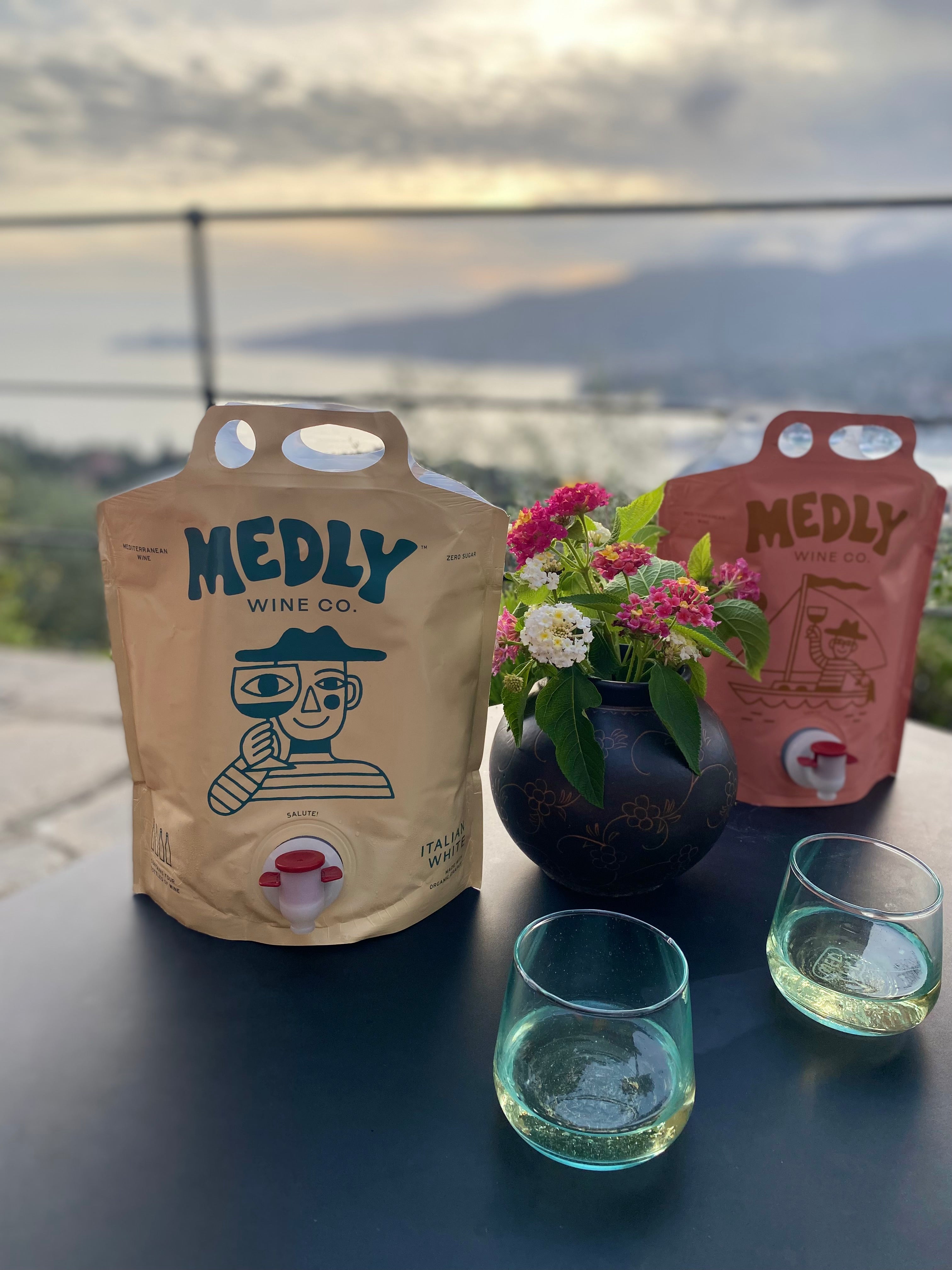
Some of that history is still working the land today. Medly's own French Red and French Rosé come from a family of independent winegrowers in Corbières-Boutenac, in the Languedoc-Roussillon, who have farmed the same estate since 1605.

What Actually Sets French Wine Apart
Most New World labels lead with the grape: Chardonnay, Cabernet Sauvignon, Pinot Noir. French labels lead with place and expect you to already know what's inside. A Burgundy label says "Chablis," not "Chardonnay," because under the AOC system the place already dictates the grape, the yield, and often the method.
That system runs on three tiers, from the strict, traditional AOC (also called AOP) down through IGP to the far more flexible Vin de France, each one trading regulation for freedom. It's a deep enough topic to deserve its own breakdown, and we get into the tiers in more detail elsewhere on the blog. For now, the short version is this: the stricter the tier, the more the region itself, rather than the winemaker, decides what's in the bottle.
How French Wine Is Actually Made
Inside an AOC, the rules go well beyond "grown in this place." Appellations can cap yields, dictate permitted grape varieties, set minimum alcohol levels, and in some of the most traditional appellations, require specific vineyard and cellar practices. That's part of why regions taste so consistent year to year: the winemaker has less room to improvise than a New World producer with an open label.
At the same time, France is where a lot of today's low-intervention winemaking actually started. In Beaujolais in the 1980s, chemist and négociant Jules Chauvet and winemakers like Marcel Lapierre showed that stable wine could be made with native yeast and little to no added sulfur, proving the idea could work commercially and not just in theory. That thinking eventually became official: in 2020, France introduced the Vin Méthode Nature label, which requires certified organic grapes, native yeast fermentation, no additives during vinification, and a hard cap of 30 milligrams per liter of total sulfites, well under the roughly 150 to 200 mg/L allowed in conventional reds.
It's worth untangling two terms that get used almost interchangeably. Certified organic describes how the grapes were farmed: no synthetic pesticides or herbicides in the vineyard, independently verified by a certifying body. "Natural" describes what happens after the grapes are picked: minimal cellar intervention, native yeast, little to no added sulfites, often no fining or filtration. Organic farming is usually the starting point for a natural wine, but a wine can be made from certified organic grapes and still go through a fully conventional cellar process.
|
Certified organic |
Natural (Vin Méthode Nature) |
|
|---|---|---|
|
What it verifies |
Vineyard farming only |
Farming, plus what happens in the cellar |
|
Grapes |
Must be certified organically grown |
Must be certified organically grown |
|
Cellar process |
Not covered by the certification |
Native yeast only, no additives during vinification |
|
Sulfite limit |
Not specified by organic certification itself |
Capped at 30 mg/L total (or zero for the strictest tier) |
|
Who verifies it |
ECOCERT, AB, EU Organic, and similar bodies |
Currently a France-specific label, established in 2020 |
They're related ideas, not interchangeable ones. A wine can be one, both, or, more often than shoppers assume, neither.
Where It's Sourced: Certified Organic Vineyards and Family Estates
France now farms roughly a fifth of its vineyard land under certified organic standards, the largest organic vineyard footprint in Europe. Spain, France, and Italy together account for about 75% of the world's certified organic vineyard land, and within France, the Languedoc alone makes up around 35% of the country's total organic vineyard area, more than any other region.
That's exactly where Medly's own French wine is grown. The family estate in Corbières-Boutenac began converting its vineyards to certified organic farming in 1991, the same year the EU first formalized organic agricultural regulation, putting them ahead of the curve rather than following a trend. I've spent time walking those rows with the family since moving to the Mediterranean myself, and a decision they made decades before organic was a selling point still shows up directly in the glass.
Today those certified organic vineyards, verified under ECOCERT, grow the Malbec, Cinsault, Grenache Noir, Merlot, Carignan, Syrah, and Cabernet Sauvignon that go into Medly's French Red, a blend built for cold-weather pairings as much as everyday drinking. This is usually what people are actually looking for when they search for organic French red wine: fruit grown on certified organic land, not a certification on the finished bottle itself. We walk through more of that sourcing story, and why it matters to us specifically, in Organic Wines in France: A Return to the Earth and the Future of Winemaking.
Are All French Wines Organic?
No, and it's a common assumption worth correcting. Roughly 20 to 22% of French vineyard land is certified organic. That's a genuinely large share by global standards, but it still means the large majority of French wine, including plenty of well-known AOC producers, is conventionally farmed unless the label says otherwise.
The good news is that the label tells you directly. Look for the AB mark (Agriculture Biologique) or the EU organic leaf, both official certifications rather than marketing language. A wine can also be labeled "en conversion" during the mandatory transition period before certification kicks in. We go deeper on how those certifications actually work, and how they differ from vague "clean wine" claims, in Understanding Organic Wine Certifications and Organic vs Conventional Wine: What's the Difference?
Medly's French Red and French Rosé are both grown on certified organic vineyards, verified under ECOCERT, and made with grapes, native yeast, and minimal sulfites (30 to 50 parts per million) only, well under the roughly 150 to 200 mg/L found in most conventional wine. We get into how that whole process works, from the vineyard to the pouch, in The Journey from Vine to Package: How Organic Wine is Made.
What Ties It All Together
France's wine identity was never really about one grape or one region. It's the combination of centuries-old place-based law, family estates that have worked the same soil for generations, and, increasingly, a real commitment to certified organic and low-intervention farming that started here before it was a global trend. That's the Mediterranean thinking we lean into at Medly, not Mediterranean-inspired, but Mediterranean, sourced from the family estates who've been doing this the longest.

FAQ
Is French natural wine the same as organic French wine?
No. Certified organic describes vineyard farming, no synthetic pesticides or herbicides, independently verified. Natural wine describes the cellar process: native yeast, minimal or no added sulfites, little to no filtration. Organic farming is usually the foundation of a natural wine, but the two labels aren't interchangeable.
Are all French wines organic?
No. Around 20 to 22% of French vineyard land is certified organic, the largest share in Europe, but that still leaves most French wine conventionally farmed unless the bottle carries a certification like the AB mark or the EU organic leaf.
What does "certified organic vineyards" mean?
It means the grapes were grown without synthetic pesticides, herbicides, or fertilizers, verified by an independent certifying body such as ECOCERT. It describes the farming, not a claim about the finished wine itself.
What is Vin Méthode Nature?
It's the French government's 2020 certification for natural wine. It requires certified organic grapes, native yeast fermentation, no additives during vinification, and a cap of 30 mg/L total sulfites for its strictest tier.
Where does Medly's French wine come from?
Corbières-Boutenac, in the Languedoc-Roussillon, farmed by the same family since 1605. Their vineyards have been certified organic under ECOCERT since 1991.