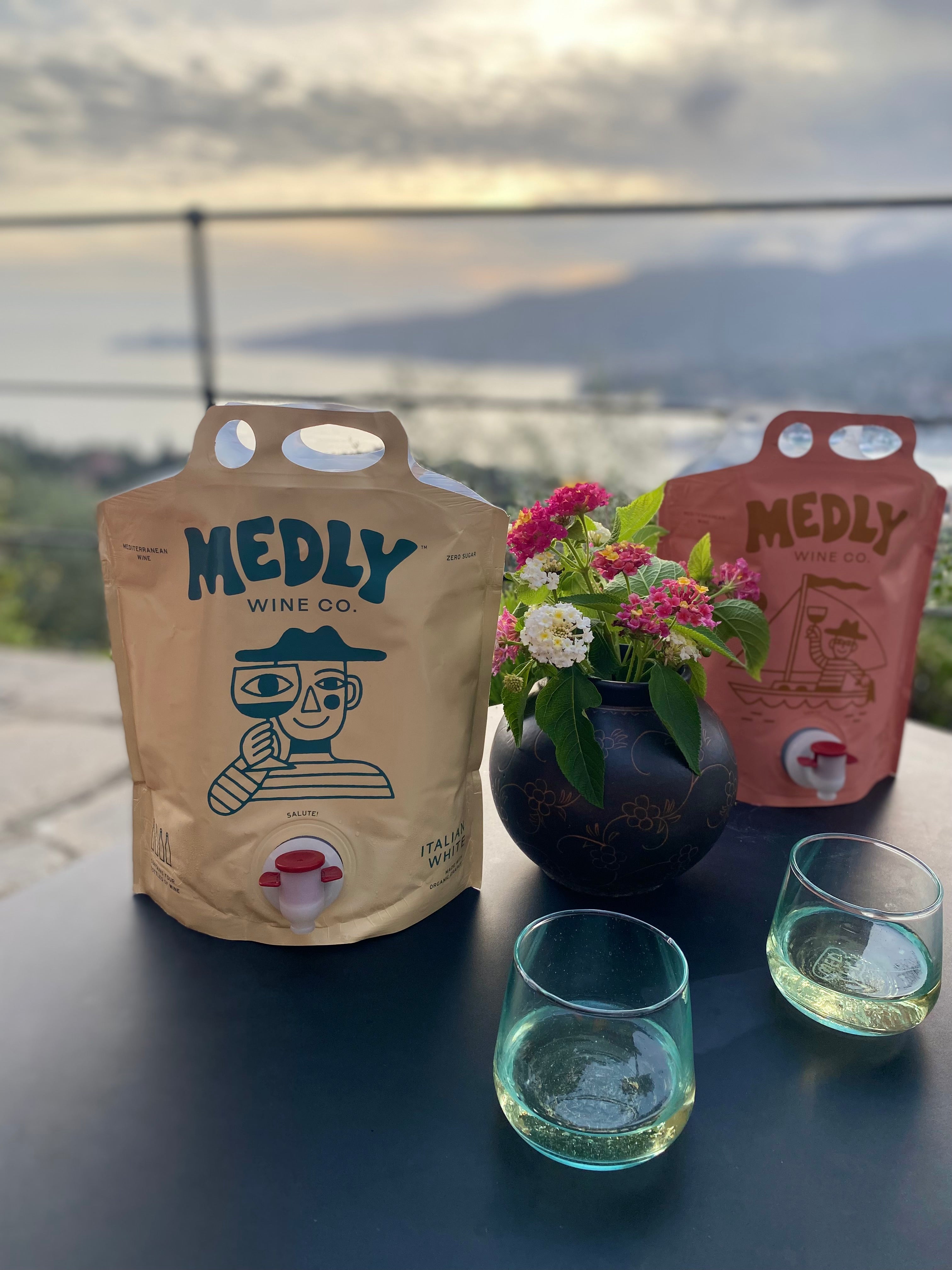
Natural Italian wine and low-intervention wine describe two different things that get talked about as one. Certified organic describes how a vineyard is farmed. Low intervention describes what happens, or doesn't happen, once the grapes are picked. Italy has spent the last two decades building a real movement around both, with its own farming history, its own certifying and monitoring bodies, and vineyards from Friuli to Sicily proving the case harvest after harvest.
This piece covers where that movement actually comes from: the ancient roots of Italian winemaking, how the country built one of the largest certified organic vineyard footprints in the world, the specific producers and associations behind Italy's low intervention wine movement, and how a vineyard in Sicily, the same region Medly sources from, manages its vines today
.
Quick Guide: Natural Italian Wine and Low Intervention Winemaking
-
Natural Italian wine and low intervention wine aren't legally regulated terms the way DOC or DOCG are. They describe farming and cellar choices, layered on top of or independent from official certification.
-
Certified organic describes vineyard farming: no synthetic pesticides, herbicides, or fertilizers, verified annually by a body like ICEA. Low intervention describes the cellar: native yeast, little to no added sulfites, minimal filtering.
-
Italy farms roughly 132,000 hectares of certified organic vineyard, about a fifth of its total vineyard land and the third-largest organic vineyard footprint in the world behind France and Spain.
-
Sicily and Tuscany lead the country's organic vineyard conversion, with Sicily standing out as Italy's largest organic wine region by land under vine.
-
Italy's own natural wine associations, VinNatur among them, set rules stricter than organic certification requires, and Friuli's amber wine pioneers reintroduced amphora fermentation methods older than the Roman Empire.
-
Medly's own Italian wine comes from a family vineyard in Trapani, Sicily, certified organic since the late 1990s and now farmed by the sixth generation of the same family.

Wine Has Been Made in Italy Longer Than "Italy" Has Existed
Greek colonists arriving on the southern coast around the 8th century BCE found so much wild and cultivated grapevine already growing there that they named the region Oenotria, roughly "land of the staked vine." Further north, the Etruscans, centered in what's now Tuscany, were cultivating vines and fermenting wine in earthenware vessels well before Rome rose to power. Rome later scaled production and carried viticulture across the empire, but the groundwork, crushing grapes by foot and fermenting in clay with little else added, had already been laid by the people who came before it.
That history matters here because natural wine often gets described as a recent invention. In Italy, it's closer to a return. The amphora fermentation and minimal handling the Etruscans practiced is, in method if not in name, close to what modern low intervention producers are doing again today, a thread this piece picks back up in Friuli.
How the Modern Organic Movement Took Root in Italian Vineyards
Like most of European agriculture, Italian viticulture spent the decades after World War II leaning harder on synthetic fertilizers, herbicides, and high-yield farming. Organic methods started re-emerging in Italian vineyards from the 1970s onward, part of a broader European shift, but for a long time certification only ever covered the grapes. The EU didn't regulate organic winemaking itself, the cellar process and not just the vineyard, until 2012.
Today Italy farms roughly 132,441 hectares of certified organic vineyard, about 22 percent of the country's total vineyard area, according to Ismea's 2025 "Bio in Cifre" report. That makes Italy the third-largest certified organic vineyard footprint in the world, behind France and Spain, with Sicily and Tuscany leading the country's own conversion. Certification in Italy runs through bodies like ICEA, alongside the AB and EU Organic marks recognized across the bloc, the same certifications behind Medly's own vineyard verification. We've covered how that shift played out region by region in The Rise of Organic Wines in Italy.
Low Intervention Is a Different Claim Than Organic, and Italy Has Its Own Movement Proving the Difference
The two terms get used almost interchangeably, but they're not answering the same question. Certified organic verifies how the grapes were farmed. Low intervention, sometimes called natural or vino naturale, describes what happens after harvest: fermentation with native, ambient yeast instead of a commercial strain, little to no added sulfites, and minimal or no fining and filtration. Organic farming is usually the starting point for a low intervention wine, but a vineyard can be certified organic and still run a fully conventional cellar process.
|
Certified organic |
Low intervention / natural |
|
|---|---|---|
|
What it verifies |
Vineyard farming only |
Farming, plus what happens in the cellar |
|
Grapes |
Must be certified organically grown |
Usually certified organically or biodynamically grown |
|
Cellar process |
Not covered by the certification |
Native yeast, little to no added sulfites, minimal filtering |
|
Who verifies it |
ICEA, AB, EU Organic, and similar bodies |
No single legal standard in Italy; associations like VinNatur set their own charter |
VinNatur is the clearest example of that second column. Founded in 2006 by winemaker Angiolino Maule in the Veneto, the association now counts more than 300 winemaker members across 12 countries. In 2016, VinNatur adopted a charter stricter than organic regulation requires, and since 2019 it has tested every member wine for pesticide residue and sulfite levels, a level of finished-wine scrutiny that organic certification alone doesn't cover. It is, in effect, Italy's own answer to the question of what "natural" should actually mean when nobody legally has to define it.
The Amphora Revival: How Friuli Rewrote the Rules for White Wine
Nowhere shows how far low intervention can go more than Friuli-Venezia Giulia, in Italy's northeast corner near the Slovenian border. The Gravner family had farmed and bottled wine in Oslavia since the early 1970s, making conventional blends, until a 1987 trip to the United States left winemaker Josko Gravner disillusioned with industrial winemaking. A devastating hailstorm in 1996 pushed him toward extended skin contact, and a trip to Georgia in 2000 introduced him to qvevri, the buried clay amphorae Georgian winemakers have used for millennia. By 2001, Gravner had buried his first 11 qvevri in his own cellar and committed to fermenting his white Ribolla Gialla on its skins for months at a time, aging it for years afterward in large oak. He's now widely credited as the father of Italy's modern amber, or orange, wine movement.
His neighbor Stanko Radikon followed a similar path, starting full skin-contact vinification in 1995 and farming organically, then removing sulfur from his wines entirely by 2002. Between them, Gravner and Radikon turned a technique nearly as old as Italian winemaking itself, fermenting in clay with minimal handling, into the modern reference point for what low-intervention winemaking can produce.
That range is the point. Low intervention in Italy doesn't look like one style or one region. It's Friuli's amber whites on one end and, on the other, everyday reds like Barbera in Piedmont, a grape that stayed close to native yeast and simple cellar work for generations because it was the wine locals actually drank at dinner, not the one built for export. We cover that grape's own history in What Is Barbera Wine? The Straightforward Guide from an Italian Wine Lover, and it's the tradition behind Medly's Italian Red, Limited Release. It's a different expression of the same idea covered across Italy's classification system, which we break down more fully in Italian Wine Classifications: A Smart Girl's Guide to Sipping with Confidence, and it shows up differently again across the country's best-known wine regions, covered in 5 Most Famous Wine Regions in Italy.
How Vineyards Are Actually Managed Under Certified Organic and Low Intervention Practices
Certified organic farming rules out synthetic pesticides, herbicides, and fertilizers, verified annually and preceded by a multi-year transition period before a vineyard can be certified at all. In place of those tools, growers lean on cover crops, compost, and crop rotation to keep soil healthy, and on copper and sulfur, both capped by regulation, plus beneficial insects and vineyard design to manage pests and disease instead of systemic chemicals. Some estates go further into biodynamic practices, treating the vineyard as a single connected system rather than a set of separate inputs to manage, a farming philosophy we go deeper on in Regenerative Agriculture: Biodynamic Farming and the Benefits of a Biodiverse Environment.
Native yeast fermentation is where low intervention winemaking really shows up. Instead of inoculating must with a commercial yeast strain bred for predictability, low intervention producers let whatever yeast is already present on the grape skins and in the cellar do the work. It's less consistent harvest to harvest, but it's also the reason two low intervention wines from neighboring vineyards can taste noticeably different even when they're made from the same grape. The same transparency argument runs through what actually separates clean, low intervention wine from a heavily corrected conventional one, which we cover in Clean Wines vs Conventional Wines and Organic vs Conventional Wine: What's the Difference?
Sicily, Where Medly's Own Italian Wine Comes From
Sicily is Italy's largest wine region by vineyard area, and it's also one of the country's organic leaders alongside Tuscany. The island's warm, dry Mediterranean climate genuinely helps here: the fungal pressure that drives most conventional spraying elsewhere is lower to begin with, which makes organic farming a more natural fit than it is in damper regions further north. Sicily's native grapes carry that identity directly into the glass: Nero d'Avola for structured reds, and Grillo, Catarratto, and Inzolia for the island's aromatic whites.
Trapani, on Sicily's western tip, sits in the heart of that landscape, and it's exactly where Medly's own Italian wine is grown. The family behind it has farmed there long before "certified organic" was a label anyone asked for, converting in the late 1990s and now working the same vineyards as the sixth generation. I've walked those rows myself since moving to the Mediterranean, and it's clear the certification only confirms what the family was already doing. Their fruit becomes Medly's Italian White, made from grapes, native yeast, and minimal sulfites only, the same three-ingredient standard behind every wine in the collection. If you want the fuller story of how that sourcing decision came together, we cover it in Medly Wine from Vineyard to Glass: The Journey Behind Every Pouch.
What Ties It Together
Italy's low intervention and natural wine movement isn't a marketing layer added on top of old traditions. In method, it's closer to a return to how Italian wine was made before industrial shortcuts arrived, practiced today by everyone from Friuli's amphora producers rewriting what white wine can be, to small certified organic family estates in Sicily doing the same work their grandparents did. That's the thinking behind every wine in Medly's collection, not a trend borrowed for a label, but a farming and winemaking approach some Italian families never actually left.

FAQ
What does "low intervention wine" mean?
It describes minimal handling after the grapes are picked: fermentation with native, ambient yeast instead of a commercial strain, little to no added sulfites, and minimal or no fining and filtration. It's a winemaking approach, not a legal certification.
Is natural Italian wine the same as certified organic Italian wine?
No. Certified organic verifies how the grapes were farmed, with no synthetic pesticides, herbicides, or fertilizers, independently checked by a body like ICEA. Natural or low intervention describes the cellar process afterward. Organic farming is usually the foundation of a natural wine, but the two aren't interchangeable claims.
What is VinNatur?
VinNatur is an Italian natural wine association founded in 2006 by winemaker Angiolino Maule, now representing more than 300 producers across 12 countries. Since 2016 it has run its own charter stricter than organic regulation, and since 2019 it has tested every member wine for pesticide residue and sulfite levels.
How are vineyards farmed under certified organic standards in Italy?
Without synthetic pesticides, herbicides, or fertilizers, verified annually after a multi-year transition period. Growers rely on cover crops, compost, and crop rotation for soil health, and on capped copper and sulfur use, beneficial insects, and vineyard design for pest and disease control.
Where does Medly's Italian wine come from?
Trapani, on the western tip of Sicily, farmed by the same family since the late 1990s and now in its sixth generation of certified organic farming.