Europe grows the overwhelming majority of the world's organic wine grapes. France, Spain, and Italy alone hold more than three-quarters of the world's certified organic vineyard acreage, according to the most recent FiBL and IFOAM organic agriculture survey.
The United States, by comparison, has about 17,000 hectares under organic vine, a rounding error next to France's 157,000. That gap didn't happen by accident. It's the result of a decades-long head start in farming philosophy, a regulatory framework built specifically for wine, and a market that's been asking for it far longer than ours has.
Here's how Europe got there first, why American regulation makes the finish line look different here, and where U.S. producers are actually gaining ground.
Quick Guide: Europe vs. the U.S. on Organic Wine Production
-
France, Spain, and Italy together hold more than three-quarters of the world's certified organic vineyard acreage. The U.S. holds a small fraction of that.
-
Europe's organic farming movement in vineyards traces back nearly a century, to Rudolf Steiner's 1924 biodynamic lectures and Demeter's 1928 certification, decades before any government organic standard existed.
-
The EU didn't regulate organic winemaking itself, not just the grapes, until 2012, under Regulation 203/2012. Before that, even European producers could only certify the grapes.
-
The U.S. system is stricter in one specific way: a wine can only carry the full USDA Organic seal if it has no added sulfites at all. Most producers, in Europe and the U.S. alike, add some, so they land in a separate "made with organic grapes" category instead.
-
That one rule is a big part of why organic vineyard growth in the U.S. has lagged, even though organic farming itself is well understood and increasingly practiced here.
-
California, Oregon, and a handful of other states are adding certified organic acreage every year. The gap is closing. It's just closing slowly.
A Century Head Start: Where Europe's Organic Movement Actually Began
Long before "organic" was a label anyone regulated, European farmers were already practicing the underlying idea.
The clearest starting point is 1924, when Austrian philosopher Rudolf Steiner delivered a series of agricultural lectures in Koberwitz, Silesia (now part of Poland), laying out the principles that became biodynamic farming: treating a vineyard as a self-contained living system rather than a set of inputs to manage. Four years later, in 1928, German biodynamic farmers formalized those ideas into Demeter, a certification that still exists today and is considered the oldest ecological farming certification in the world.
France's own organic farming movement dates to 1963, when agronomists Raoul Lemaire and Jean Boucher founded AFAB, the French Association of Organic Agriculture. Nature et Progrès grew out of that same era to become one of the country's original organic certifying bodies. All of this predates the U.S. Department of Agriculture's National Organic Program by decades; the USDA didn't finalize its national organic standards until 2002.
I spent years running a small organic vineyard and winery in southwestern Colorado before Medly, and even then, in the 2010s, getting a U.S. vineyard certified organic still felt like a niche decision that took real explaining to distributors and customers alike. Walking vineyards in Languedoc and Sicily now, where certified organic and regenerative practices have been standard for whole families across generations, the difference in how normalized it is stands out immediately. It's not treated as a premium add-on. It's just how the estate has always farmed.
Some of that same farming ethic, applied to how a vineyard treats its soil and surrounding ecosystem, gets covered in more depth in our look at regenerative and biodynamic farming.

The Regulatory Difference: How the EU Actually Defines an Organic Label for Wine
Farming philosophy explains why Europe started early. Regulation explains why the gap is still measurable today.
Until 2012, European wine had the same limitation American wine still has: certifiers could verify that grapes were grown organically, but nothing in EU law governed what happened to that fruit once it reached the winery. A bottle could reference organically grown grapes, but nothing on the label could speak to the finished wine itself.
Regulation 203/2012 changed that. Effective August 2012, it laid out specific winemaking rules, covering sulfite limits, permitted additives, and process restrictions, that a finished wine has to meet to carry the EU's organic seal, not just the vineyard behind it. Under that regulation, dry red wines can carry up to 100 milligrams per liter of total sulfur dioxide and still qualify; white and rosé wines can carry up to 150. Both ceilings sit meaningfully below what's allowed in conventionally made wine.
|
|
|||
|---|---|---|---|
|
Label Category |
Region |
Sulfite Limit |
Covers |
|
EU organic label |
European Union |
100 mg/L (red), 150 mg/L (white/rosé) |
Grapes and winemaking process |
|
USDA Organic |
United States |
No added sulfites |
Grapes and winemaking process |
|
Made with Organic Grapes |
United States |
Up to 100 ppm added |
Grapes only; winemaking not regulated the same way |
Why the U.S. Label Works Differently
Here's the part that trips up a lot of American shoppers: the U.S. actually applies a stricter sulfite rule than Europe does, and it's a big reason so few U.S. wines carry the full USDA Organic seal.
According to the USDA's own guidance, a wine can only use the USDA Organic label if it has no added sulfites at all during production. Very few producers, anywhere, make wine that way, because sulfites are also what keep most wine shelf-stable and consistent bottle to bottle. Wines that fall short of that threshold, which is most of them, land in a second, lower-profile category instead: "made with organic grapes." That version can carry up to 100 parts per million of added sulfur dioxide, and every grape used has to be certified organic, but the bottle can't display the USDA seal.
This is also why wine grown on certified organic vineyards in Europe often gets described carefully in U.S. content. The farming can meet rigorous organic standards under European certifiers like ECOCERT or ICEA, but because the finished wine was made and labeled under EU sulfite rules rather than USDA ones, U.S. regulations don't currently treat the two labeling systems as equivalent. It's a labeling technicality more than a quality one, but it's a real one, and it's why you'll often see wine described by its certified organic vineyards and grapes rather than by a broader organic wine claim in U.S. markets, even when the underlying farming has been organic for decades. For more on how certifiers verify all of this in the first place, our breakdown of organic wine certification bodies covers ECOCERT, ICEA, CCOF, and the rest.
Which Countries Actually Grow the Most Organic Wine Grapes
Regulation explains the rules. Geography and scale explain the numbers.
According to the FiBL and IFOAM "World of Organic Agriculture" report, the most recent global count puts organic vineyard area at roughly 562,000 hectares worldwide. Three countries account for nearly all of it.
|
|
||
|---|---|---|
|
Country |
Organic Vineyard Area |
Share of Country's Total Vineyard |
|
France |
157,358 hectares |
Largest organic vineyard area worldwide |
|
Spain |
149,934 hectares |
Second-largest organic vineyard area worldwide |
|
Italy |
127,638 hectares |
18.1% of Italy's total vineyard |
|
United States |
17,111 hectares |
A small fraction of the total U.S. vineyard |
Between them, France, Spain, and Italy hold more than three-quarters of the world's certified organic vineyard land. Italy alone has completed the conversion of over 100,000 of its organic hectares, and the country now accounts for close to a quarter of the world's organic vineyards on its own.
France and Italy have each built entire chapters of their modern wine industries around this shift. France's organic winemaking momentum and Italy's rise as an organic wine producer both trace back to the same regional commitment that shows up in the numbers above.
France's Languedoc region, where Medly's French red and rosé are grown, has been part of that shift long before it was fashionable. The family estate behind Medly's French wines started converting to organic farming in 1991, more than two decades before the EU had rules for organic winemaking at all. The day-to-day mechanics of what that conversion actually involves, from soil health to pest management, are covered in our guide to organic growing.
How the U.S. Is Catching Up
The gap is real, but it's shrinking, and it's shrinking specifically where growers are willing to absorb the cost and paperwork of certification.
California added more than 1,700 acres of newly certified organic wine grape vineyard in a single recent year, according to the USDA Organic Integrity Database. Jackson Family Wines certified 15 additional Napa vineyards in 2023, and Scheid Family Wines has built its Central Coast organic footprint to 667 certified acres, the largest of any CCOF-certified grower in the region. Regenerative viticulture is picking up momentum, too: Paso Robles launched a "One Block Challenge" in January 2025, giving growers a low-risk way to convert a single block of vines to regenerative practices.
None of that closes a gap measured in hundreds of thousands of hectares overnight. But it's a meaningfully different trajectory than a decade ago, when U.S. organic vineyard acreage was reportedly shrinking in several regions rather than growing. More producers now treat organic and regenerative certification as a market differentiator instead of a niche cost center, which is roughly the same shift that happened across France and Italy a generation earlier.
What This Means for What's in Your Glass
None of this regulatory back-and-forth changes what actually happens in the vineyard. A grape grown without synthetic pesticides or herbicides is grown that way, whether the finished bottle can legally carry an organic wine label in a given country or not. Our breakdown of organic versus conventional wine covers what that farming difference actually changes in the glass.
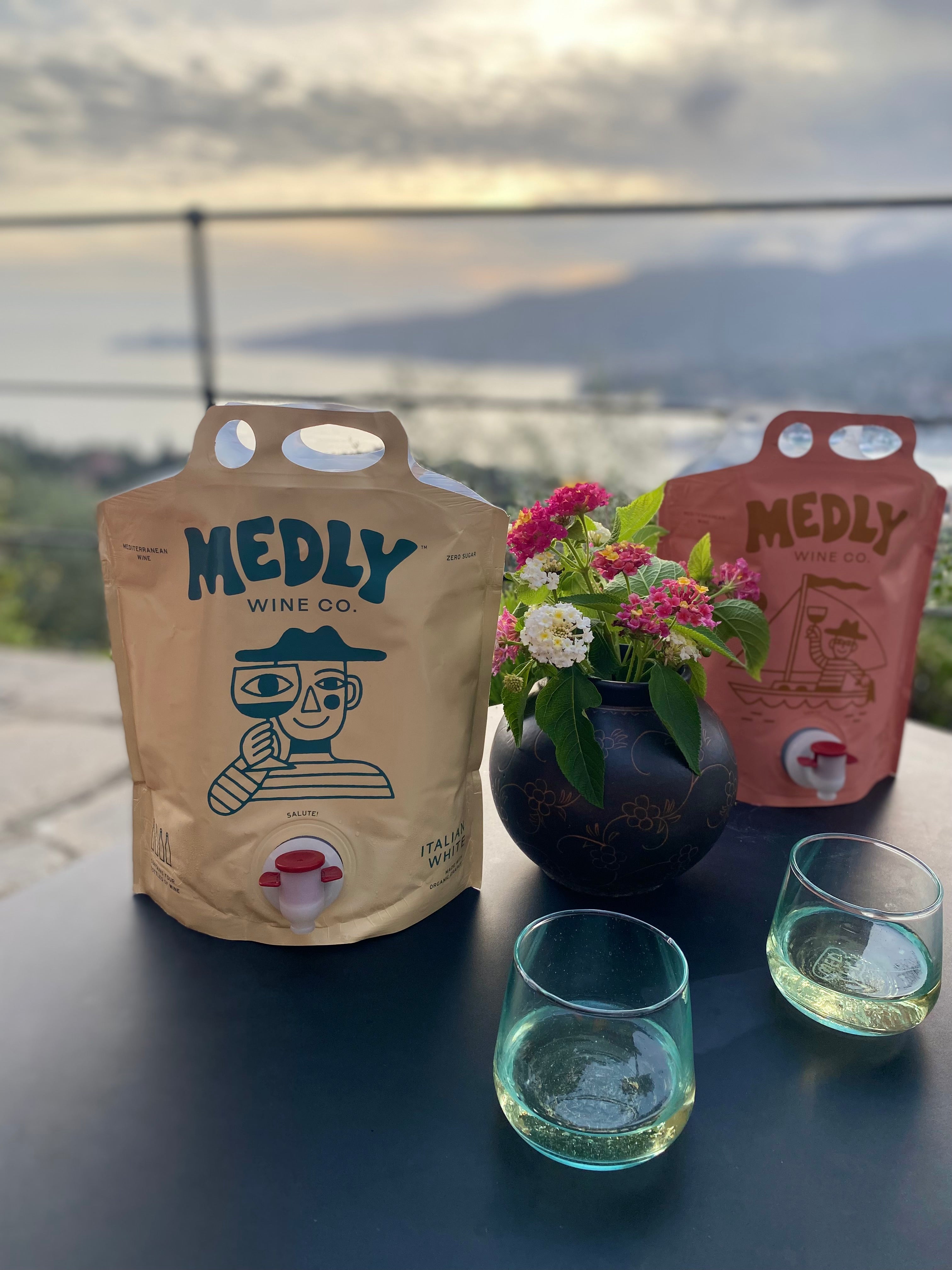
That's the distinction I try to keep front and center. Medly's wines come from certified organic vineyards on family estates in the Languedoc region of France and in Trapani, Sicily, that have been farming this way for decades, long before any label required it. Whatever a given market's rules say, the grapes and the growing haven't changed.
You can see the wines those vineyards produce in our French Red and Italian White, or browse the full Medly collection to see how each bottle traces back to the estate behind it.

Frequently Asked Questions About Organic Wine Production
What's the difference between an organic wine label and a wine "made with organic grapes"?
In the U.S., a wine carrying the full USDA Organic seal can't have any sulfites added during production. A wine labeled "made with organic grapes" uses 100% certified organic grapes but allows up to 100 parts per million of added sulfites, and it can't carry the USDA seal.
Why do some European wines from organic vineyards avoid the "organic wine" label in the U.S.?
Because U.S. and EU rules for the finished wine differ, even when the grape-growing standards are similarly rigorous. The EU allows an organic label on wine with more added sulfites (100 to 150 mg/L) than the USDA allows for its organic seal. Wine that meets EU organic standards but exceeds the USDA's near-zero sulfite threshold typically gets described by its certified organic vineyards and grapes instead.
Which countries produce the most organic wine grapes?
France, Spain, and Italy lead by a wide margin, together holding more than three-quarters of the world's certified organic vineyard area, according to FiBL and IFOAM's most recent global survey.
Is organic wine required to have no sulfites?
No. Sulfites occur naturally in all wine and are commonly added as a preservative. Organic certification limits how much can be added; it doesn't eliminate sulfites altogether, except under the strictest USDA Organic category specifically.
Is the U.S. catching up to Europe in organic wine production?
Slowly. California and a handful of other states are adding certified organic vineyard acreage every year, and major producers are investing in both organic and regenerative certification. The U.S. still represents a small fraction of the world's organic vineyard area, but the trajectory is upward.