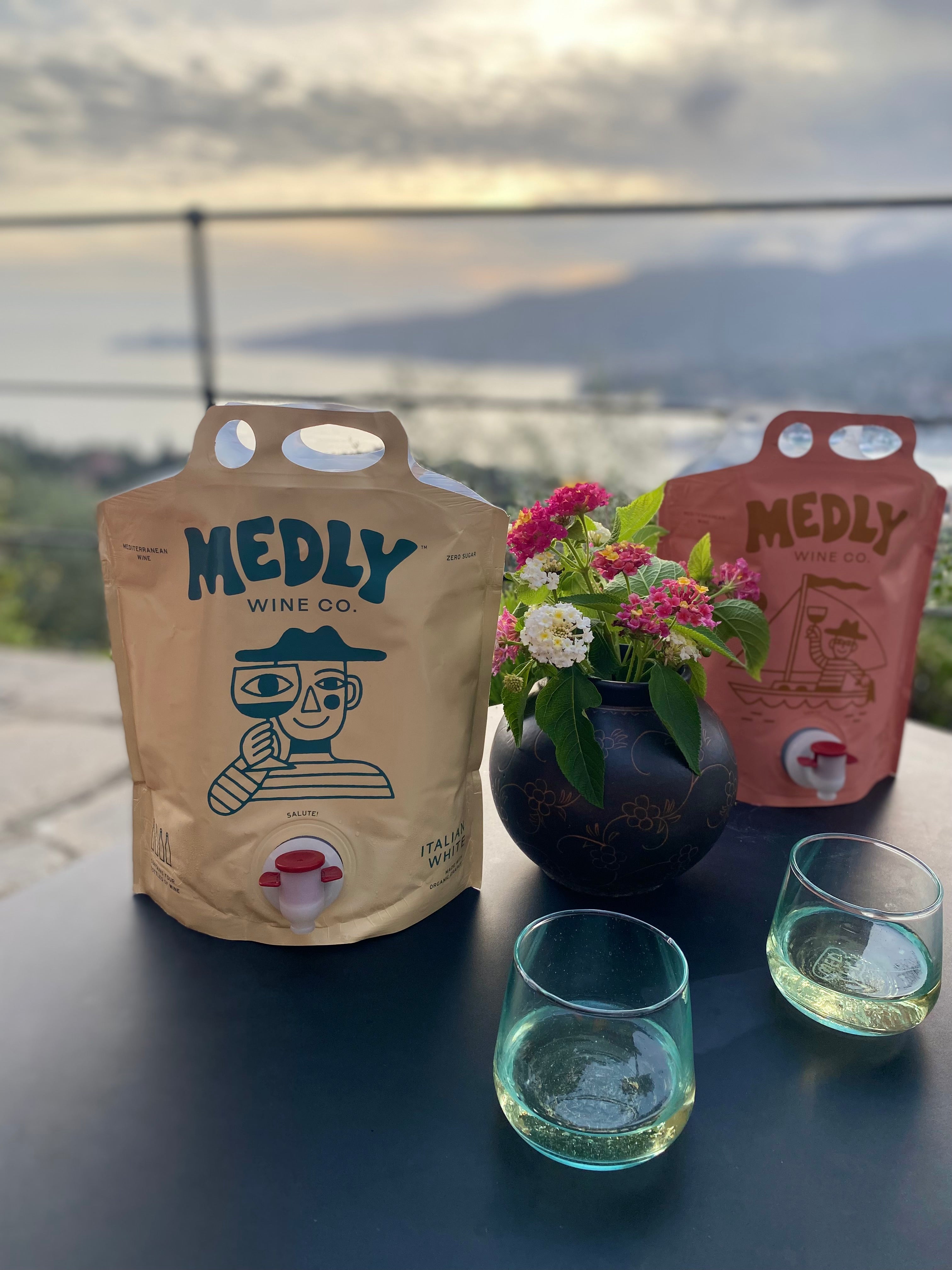
Every decision behind a Medly wine gets made twice. Once for how it tastes, and once for whether it holds up to how it’s made. Where the grapes come from, how those vineyards are farmed, what does and doesn't go into the tank, and why the finished wine ships in a wine pouch instead of a bottle: none of it is incidental. Here's the reasoning behind each choice, from the two families we work with in the Mediterranean to the spigot you'll pour from tonight.
Quick Guide: The Reasoning Behind Every Medly Wine
-
Two families, not a broker. Every Medly wine comes from vineyards in Corbières, France, and Trapani, Sicily, farmed by families we've worked with directly for years.
-
Certified organic vineyards, inspected annually. ECOCERT and ICEA audit the French and Italian estates every year against AB and EU Organic standards.
-
Three things in the tank. Grapes, yeast, and minimal sulfites (30 to 50 ppm) is the entire ingredient list, well under the FDA's 100 ppm allowance for wine made from organic grapes.
-
The wine pouch is an enhancement, not a shortcut. It ships lighter, blocks oxygen after opening, and keeps the last pour tasting like the first.
-
The result shows up in the glass. Fewer additives and a shorter path from harvest to your door mean the fruit does the talking, not a lab.
Why the Mediterranean, and Not Somewhere Easier
I could have sourced Medly's wine from almost anywhere. Grapes grow on six continents. What I couldn't replace was the relationship, and that's why every bottle (well, pouch) traces back to two families in the Mediterranean rather than a distributor's catalog.
In Corbières, in France's Languedoc region, we work with a family that has grown grapes and made wine independently since 1605. They pioneered the conversion to certified organic farming back in 1991, long before "organic" was a marketing word anywhere in the wine industry. In Trapani, on the western tip of Sicily, we work with a family now on its sixth generation, certified organic since the late 1990s. I know both families personally. I've walked their rows, eaten at their tables, and watched a harvest come in. That's a different kind of sourcing than picking a grape varietal off a spec sheet, and it changes what you're willing to say no to. If a lot doesn't meet the standard, it doesn't go in the pouch, full stop.
This is also why we're precise about the word "Mediterranean" in our name and our marketing. It isn't a mood board. It's two actual places, farmed by two actual families, and we've written more about what that distinction means in Not "Mediterranean-Inspired." Mediterranean. If you want the fuller story of how a harvest becomes a finished pouch, Medly Wine from Vineyard to Glass walks that path start to finish. This piece stays on the decisions behind it.

Why Every Vineyard Has to Be Certified Organic
Certified organic vineyards aren't a preference for us. They're a requirement, and the certifications back it up: ECOCERT in France, ICEA in Italy, both verified annually against AB (Agriculture Biologique) and EU Organic standards. That means no synthetic pesticides, no herbicides, no chemical fertilizers, full stop, checked by a third party every year, not just claimed on a label.
A quick note on phrasing, because it matters and we take it seriously: you'll notice we say "certified organic vineyards" and "certified organic grapes" here, not "organic wine." That's intentional. Our certifications are EU organic standards, and EU organic wine regulation isn't identical to the U.S. system. The Organic Materials Review Institute lays out exactly where the two frameworks diverge, particularly around added sulfites, which is one of the more contested details in the whole conversation. So we describe the farming accurately rather than borrow a label that doesn't quite translate. The vineyards and the grapes are certified organic. That's the fact we can stand behind, and it's the one that actually matters for what ends up in your glass.
The "why" behind it is straightforward: healthier soil grows better fruit, and better fruit needs less correcting later. We've gone deeper on what that farming actually looks like day to day in Organic Growing & The Path To Sustainable Wine Making, and on how regenerative practices fit into the same philosophy in our piece on regenerative and biodynamic farming. If you want the full breakdown of what each certification stamp actually requires, Understanding Organic Wine Certifications covers ECOCERT, ICEA, and the rest in detail. It's also worth knowing this isn't the same conversation as natural wine. Natural wine is mostly an unregulated, self-declared style; certified organic farming is inspected and documented. We lean on the documentation.
What Actually Goes Into Every Pouch
Here's the full ingredient list for a Medly wine:
|
What's in it |
What it is |
Why it's there |
|---|---|---|
|
Grapes |
Certified organic fruit from Corbières or Trapani |
The base of the wine, and the only source of flavor |
|
Yeast |
Converts grape sugar into alcohol during fermentation |
Necessary for wine to exist at all |
|
Minimal sulfites |
30 to 50 ppm, well under the FDA's 100 ppm allowance for wine made with organic grapes |
Keeps the wine stable in transit and after opening |
That's the entire list. No fining agents, no acid corrections, no back-sweetening, no flavor additives. Every wine ferments dry, with zero added sugar left behind, and every wine is vegan and gluten-free by nature of that short ingredient list, not because of a special process bolted on afterward.
The reason that list matters is what it leaves out. Under U.S. regulation, the Alcohol and Tobacco Tax and Trade Bureau only requires wine labels to disclose one thing: whether the wine contains 10 ppm or more of sulfites. Fining agents, acid adjustments, and flavor corrections don't have to appear on a label at all. There are 76 substances the TTB allows in U.S. winemaking without any disclosure requirement, and none of them are in a Medly pouch. We've written a longer breakdown of exactly what those substances are and how conventional wine uses them in Clean Wines vs Conventional Wines. And because fermentation runs all the way to dry, with nothing added back afterward, every Medly wine is also a genuinely sugar-free wine. We cover the fermentation chemistry behind that in Does Sugar-Free Wine Really Exist?
Why We Use a Wine Pouch, Not a Bottle
The pouch gets the most questions, so it deserves the most explanation. Two things drove the decision: what it does for freight, and what it does for freshness.
Start with weight. A standard 750 ml glass bottle weighs somewhere between 400 and 600 grams empty, before the wine even goes in. A Medly pouch, holding the equivalent of four bottles at 3,000 ml, weighs a fraction of that in packaging material. Lighter packaging means fewer trucks, less fuel, and a smaller footprint getting the wine from the Mediterranean to your door. A peer-reviewed life cycle assessment of alternative wine packaging systems in Italy found that bag-in-box format outperformed single-use glass, refillable glass, and aseptic carton across the full production and distribution cycle, largely for this exact reason. Our own numbers land in the same territory: Medly pouches produce about 85% less carbon emissions than a comparable volume in glass bottles, a figure we detail further on our sustainability page.
Then there's freshness, which is the part people notice immediately once they've tried it. The pouch collapses as you pour, instead of letting air rush in the way it does with an open bottle. That's what actually causes wine to go flat and dull days after opening: oxygen exchange, not time on its own. Because the pouch never lets that exchange happen, a Medly wine stays fresh for up to 45 days after opening, and it also means every pour gets a small amount of natural aeration on the way out of the spigot, without you doing anything extra. We've gone deeper on the mechanics of pouch versus bottle in Wine Pouches vs. Glass Bottles: Packaging for the Future, and on exactly how that 45-day number compares to an open bottle in How Long Does Wine Last? Bottles vs Pouches.
None of that would matter if the format made the wine worse. It doesn't. The pouch is packaging, not a recipe change. What's inside is the same certified organic, minimal-sulfite wine either way. The format just protects it better and ships it lighter.
The Result: What All of This Actually Means in the Glass
I've spent close to twenty years around wine, in restaurants, in distribution, and running a small organic vineyard of my own in southwestern Colorado before Medly. The thing that changed my mind about packaging wasn't a spreadsheet. It was pouring the same wine on a Tuesday and then again two and a half weeks later and not being able to tell the difference.
That's the actual point of everything above. Sourcing from two families we trust means the fruit starts in the right place. Farming certified organic vineyards means nothing has to be corrected later in the cellar. A short, honest ingredient list means what you taste is the grape and the place it came from, not a set of adjustments. And the wine pouch means that quality doesn't disappear the moment the first glass is poured. Open a French Red on a Tuesday, pour a glass, and the second glass three weekends later tastes like the same wine, because it is the same wine.
Across our Red, White, and Rosé, plus whatever exclusive drops are in rotation, the methodology doesn't change from one wine to the next. Same two families, same certified organic standard, same three-ingredient approach, same pouch. The differences you'll taste come from the grapes and the place, which is exactly how it should work.

Frequently Asked Questions
What does "certified organic vineyards" actually mean?
It means the vineyard itself is inspected annually by a certifying body (ECOCERT in France, ICEA in Italy) against AB and EU Organic standards, confirming no synthetic pesticides, herbicides, or chemical fertilizers are used in farming.
Why does Medly use a pouch instead of a bottle?
Two reasons: a pouch weighs far less than glass, which lowers shipping emissions, and it collapses as you pour instead of letting oxygen in, which is what keeps an opened wine fresh for up to 45 days instead of a few days.
What's actually in a pouch of Medly wine?
Grapes, yeast, and minimal sulfites (30 to 50 ppm), and nothing else. No added sugar, no fining agents, no flavor or acid corrections.
Is Medly wine vegan and gluten-free?
Yes, on both counts. That short ingredient list is naturally free of animal-derived fining agents and gluten-containing additives, without any separate process required.
How is this different from "natural wine"?
Natural wine is largely a self-declared style without formal inspection. Medly's vineyards are certified organic, meaning they're independently verified every year, not just labeled that way.
If you want to see the full range this methodology produces, browse the collection, or shop French Red, Italian White, and French Rosé directly, along with whatever exclusive drops are currently in rotation. You can also build your own bundle if you'd rather mix and match.