Italy has been growing grapes for a very long time, and for most of that time nobody called it organic. It was simply farming. That's how Italian vineyards worked before synthetic fertilizers and sprays took over. This guide walks through that history, from Roman vines climbing trees to the certified organic vineyards of Sicily, where growers now harvest grapes for Italian white wine. It also explains why so much organic wine can't say "organic" on a U.S. label, and how to find a good organic white wine.
The History of Wine in Italy Starts With Mixed Farming
If you picture an Italian vineyard, you probably see tidy rows of vines on bare soil. That's a fairly recent look. For most of Italy's history, vines grew up living trees, and grain, beans, or vegetables grew in the ground beneath them. Written texts and images from Roman times show the practice, and researchers who study Italy's farming history think it's even older. It has a name, coltura promiscua, which means "mixed farming." Between the 15th and 18th centuries it spread across more of the countryside, and travelers on the Grand Tour admired it. Until the first half of the 20th century, Italy was seen as the home of the practice.
What an Italian Vineyard Looked Like Before Chemicals
Walk onto an Italian farm 200 years ago and you'd see vines climbing trees that farmers trimmed back each year, with wheat, beans, or vegetables growing in the strips between them. Farmers liked to say the vine was married to the tree. Livestock grazed the grass under the branches, and vine leaves and pruning scraps went back onto the soil as fertilizer. Old farming manuals even advised planting different grape varieties in the same row, so a pest or a bad season would spare at least part of the harvest.
That system didn't come with an organic label. It was simply the toolkit farmers had. Today's regenerative and biodynamic growers talk about biodiversity in similar terms, and Medly's guide to regenerative agriculture and biodynamic farming goes deeper.
How Chemicals Reached Italian Vineyards
They arrived in two waves. A pest crisis in the 1800s pushed growers toward copper sprays, and a move to specialized farms in the mid-1900s brought in synthetic fertilizers and pesticides.
You might assume farmers always sprayed their vines. They didn't. Powdery mildew reached European vineyards from North America in 1845. Phylloxera, a root-feeding insect, followed in the 1860s, and downy mildew arrived in 1878, according to a 2026 review from France's national agricultural research institute. Growers answered with Bordeaux mixture, a spray of copper sulfate and lime that spread widely after a severe outbreak in 1886. It's worth knowing that copper is still the main tool organic vineyards use against downy mildew, more than 140 years later, and our guide to organic growing covers what that work involves today.
The second wave came after the war. Agronomists called mixed farming irrational and urged farms to specialize, with one crop per field, more machinery, and synthetic fertilizers and pesticides, and European farm policy backed that approach in the decades that followed. By the 1970s, mixed farming had almost vanished from Italy. Vines moved into dedicated vineyards, and the trees and grain left the rows.
How Western Sicily Became White Wine Country
Ships have carried wine away from Sicily's western tip for as long as anyone has made it there. According to Cantine Florio's history of Marsala, merchants and adventurers have reached this windy coast by sea since the Phoenicians, who are credited with introducing vines to Sicily. The trade took off in 1773, when a storm forced an English merchant named John Woodhouse into the harbor at Marsala. He saw the potential in the local wine, added brandy, and shipped it to England, where it became an overnight success.
More merchants followed, and the land changed with them. In the late 1700s, much of the countryside near Marsala was uncultivated and used to graze sheep. By 1820, vineyards had taken over. Marsala's white styles are built on Sicilian grapes such as Grillo, Inzolia, and Catarratto, and those grapes still anchor much of the island's white wine.
Success carried a cost. By the latter half of the 20th century, large wineries had pushed Marsala into overproduction and winemaking shortcuts, according to Haus Alpenz, and most of it ended up in the kitchen, which is why you may know Marsala only as a recipe ingredient. Since the 1980s, a small group of producers has been working to change that by going back to the vineyards and to the quality of the base wine, the plain wine that Marsala starts from. Organic farming was taking shape across Europe in those same decades, and Sicily would go on to lead Italy in it.
How Organic Farming Came Back to Italy
Farmers organized first, and the law followed. In 1972, organic pioneers met in Versailles, France, to start IFOAM, the international federation that still links organic farming groups worldwide. In 1991, Europe wrote its first legal rules for organic farming.
Italy took to it. Its roughly 133,000 hectares of organic vineyards make up about a quarter of the world total, according to figures cited by Sicily's regional wine institute. Sicily leads the country, with about 38 percent of its vineyard land farmed organically, ahead of Tuscany and Marche.
Sicilian growers point to their climate. Dino Taschetta, president of the Colomba Bianca winery, which has worked in organic production for about 30 years, says organic farming is harder and less convenient in regions with different microclimates. He adds that Sicily benefits from ideal conditions, so much so that the island could farm far more of its vineyards organically, if not all of them. One reason is water, since downy mildew needs wet leaves and humid air to spread, according to METOS, a maker of vineyard weather stations. Sicily’s climate is normally much drier, as the president of the island’s DOC consortium put it in 2023, so the disease has fewer chances to take hold.

Why Can't Most Organic Winemakers Call Their Wine Organic in the U.S.?
Because the U.S. and Europe define organic wine differently, and a wine certified in Europe still has to meet the U.S. definition before it can use the word here.
The first difference is sulfites. A U.S. “organic” wine can’t contain added sulfites, a preservative that keeps wine stable. Only the tiny amount that forms naturally during fermentation, under 10 parts per million, is allowed, according to OMRI, the group that reviews materials for organic producers. European organic rules do allow added sulfites, up to 100 ppm. So a wine made from certified organic grapes with minimal added sulfites can pass in Europe and miss the U.S. standard.
The second is certification. USDA’s labeling guide for organic wine says traded products must meet the labeling rules of the country where they’re sold. A wine certified in Italy typically needs a separate label here, and one with added sulfites has to drop the EU organic logo. It can say “made with organic grapes” instead, as long as sulfites stay under 100 parts per million, but it can’t carry the USDA organic seal.
The farming is the same on both sides of the Atlantic, and only the words the label may use change. Our look at how Europe and the U.S. compare on organic wine production puts the two systems side by side.
How Do You Find the Best Organic White Wine?
Get to know the brand. When the label can't tell you, the producer has to, so look for one that answers three questions in plain language.
-
Where do the grapes come from? A named region, and ideally a named farm or family, tells you more than "Product of Italy." A DOC or DOCG on the label also names a protected place of origin, and our guide to how Italy classifies its wines explains the system.
-
Who checks the vineyards? A brand that buys from certified organic growers should be able to name its certifiers, and our guide to what each certification requires covers the main European ones.
-
What goes into the wine? Wine labels in the United States don't have to list ingredients the way food labels do, according to TTB's list of what an imported wine label must show. Ask for the ingredient list and the sulfite level in parts per million, so you can compare brands. Our guide to clean versus commercial white wine ingredients shows how the two styles compare.
A brand that publishes those answers is showing its work, which is the job the front label can't do. The best organic white wine for you is the one whose maker can answer all three. Our comparison of certified organic and conventional farming shows what the vineyard side of that work looks like.
Where Does Medly's Italian White Wine Come From?
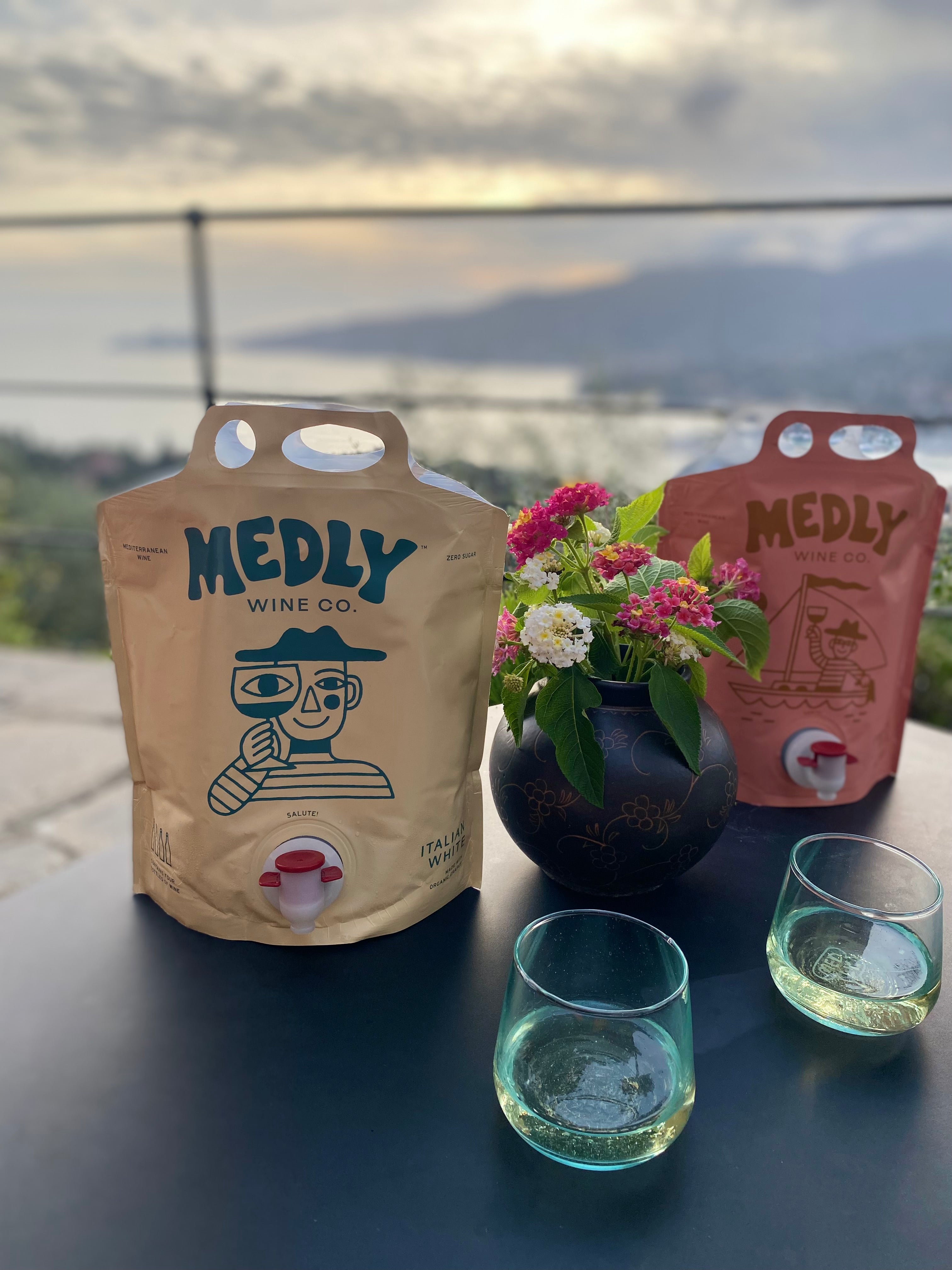
Our Italian White Wine comes from certified organic vineyards in Trapani, on the western tip of Sicily. A family has farmed there for six generations. Its vineyards have been certified organic since the late 1990s. Trapani sits in the same corner of Sicily where the Marsala trade began, and Aaron Moore, Medly's founder, has lived in the Mediterranean since 2022 and knows the family personally.
The blend pairs Pinot Grigio with Inzolia, one of Sicily's oldest grape varieties. It's fresh and crisp, fruity and dry. If you'd like to compare it with other Italian whites, our guide to white wine grape varieties is a good start.
Our ingredient list is short on purpose: grapes from those certified organic vineyards, yeast, and minimal sulfites (40 to 70 parts per million). We publish our serving facts and ingredients so you can check. Because the sulfites are added, and because the vineyards' certifications are European, our Italian White doesn't fit the U.S. "organic" label. So we say what we can show: certified organic vineyards, certified organic grapes, and a full ingredient list.
That makes it a clean, low-intervention wine made from certified organic grapes. Clean and low-intervention aren't legal labels, which is why we back them with the facts above, and our piece on Italian vineyards and low-intervention wines explains the second term. It ferments fully dry, so it has zero sugar, and it comes in at 12% ABV. Each 3-liter pouch holds the equivalent of four bottles and stays fresh for up to 45 days after opening, so you can pour a glass tonight and come back to it next week. Serve it at 40 to 45°F, and this guide to serving white wine right covers chilling and pairings.
If you'd like to taste the history above, start with our Italian White Wine. You can browse the rest of the lineup in our full Medly wine collection, or read how each pouch travels from vineyard to glass.

FAQ
What is coltura promiscua?
It's the Italian term for mixed farming, where vines, trees, and crops share the same field. Farmers trained grapevines up trimmed trees and grew grain or vegetables between the rows. It stayed common in Italy until the mid-1900s and has nearly disappeared.
Why can't most organic winemakers call their wine organic in the U.S.?
The U.S. "organic" label for wine doesn't allow added sulfites, and few winemakers make wine without them. A wine from certified organic grapes that uses sulfites can say "made with organic grapes" instead, as long as sulfites stay under 100 parts per million. Organic wine made in Europe also needs a separate U.S. label.
How do you find the best organic white wine?
Look at the brand. Ask where the grapes are grown, who certifies the vineyards, and what goes into the wine, including the sulfite level. If you can't find those answers, that tells you something.
Is Sicily the biggest region for organic vineyards in Italy?
Yes. Sicily has more than 30,000 hectares of organic vineyards, about 38 percent of its vineyard land, according to its regional wine institute. That puts it ahead of Tuscany and Marche.
Do organic vineyards in Italy still use sprays?
Yes, but only approved organic ones. Copper remains the main tool against downy mildew, and regulators cap how much growers can use.
What grapes are in Medly's Italian White Wine?
Pinot Grigio and Inzolia, grown in certified organic vineyards in Trapani, Sicily.
Is Medly's Italian White Wine zero sugar?
Yes. It ferments fully dry with no added sugar, and the serving facts list 0.13 grams of carbs per 5-ounce glass.
How long does Medly's Italian White Wine stay fresh after opening?
Up to 45 days. The pouch limits oxygen exposure, which is what makes open wine fade.